It's all here. From beginning to the end.
Daniel 2
The Structure of the Book of Daniel and Progressive Revelation
The structure of the book of Daniel gives insights into the progressive nature of the process of revelation. Any learning process takes place in stages. Personal advances in knowledge acquisition usually do not take place in quantum leaps. We learn, we learn some more, and our knowledge advances as we learn still more. We must gain some base knowledge before other knowledge can be added. No one becomes a physician after completing high school, and no one calculates a moon shot after finishing pre-algebra.
The structure of the book of Daniel teaches that there is progressive revelation in the things of God. Daniel starts by telling stories. Chapters 1-6 all contain stories about Daniel and his friends. A dream is related in chapter 7. Then in Daniel 8 we read of a vision. In Daniel chapters 9-12 there are direct communications from a heavenly messenger.
First stories, then a dream, a vision and then direct talk. In the New Testament, Jesus followed a similar pattern. Matthew tells us that Jesus was always teaching in parables. These were stories. People are interested in stories, so Daniel starts with them, and Jesus taught with them. But then Jesus would reveal the meaning of the parables to His disciples when they would seek for the meaning of the stories. Eventually, when Jesus had groomed them with stories for three years, he told them He would reveal more.
I have spoken these things to you in parables, but the time is coming when I shall no more speak to you in parables, but I will show you plainly of the Father. (John 16:25)
The disciples found that Jesus did exactly that:
The disciples said to Him, Lo, now You speak plainly and speak no parable. Now we know that You know all things and do not need that anyone should ask You. By this we believe that You have come forth from God. (John 16:29-30)
Evidently Jesus believed that speaking plainly too soon to the disciples would have been counterproductive. They would not have been ready. He needed to prepare them. The structure of Daniel follows this principle.
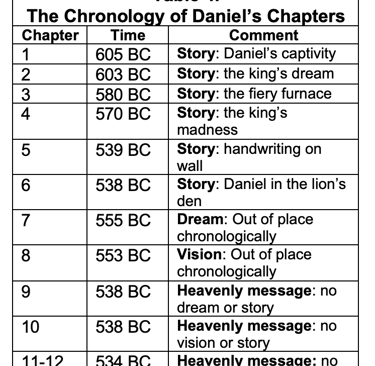
The chapters in Daniel are not given in strict chronological order. Why not? What is the organizational structure of this book if not chronological?
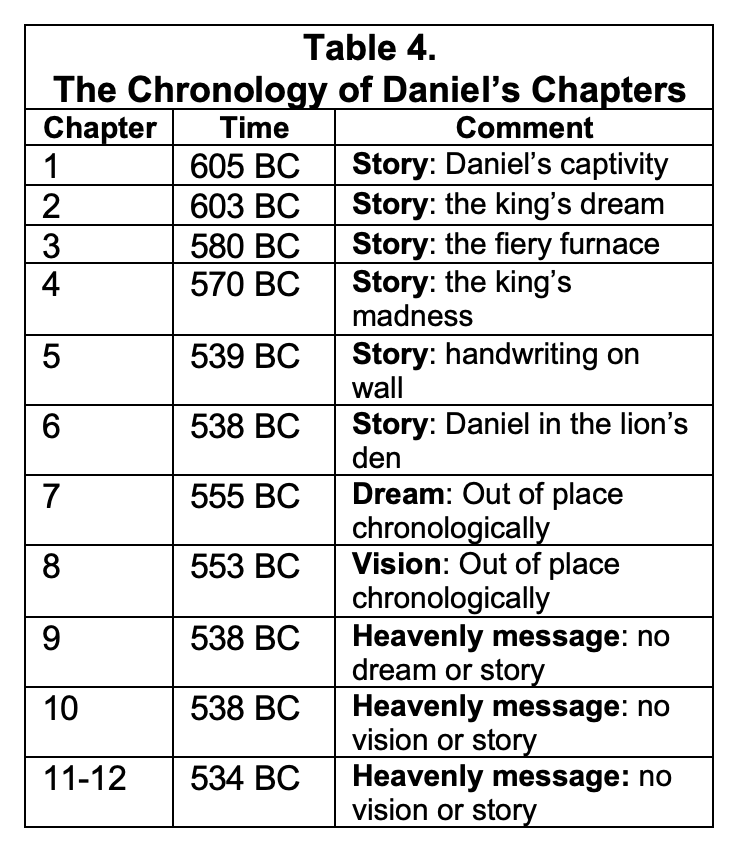
Table 4 somewhere on this page lists the chapters of Daniel and the time frame in which they took place:
Chapters 7 and 8 should really be in the sequence of 5 and 6 by strict chronology. This indicates that the chapters in Daniel were ordered with some other scheme in mind, apparently the increasing intimacy of revelation: story, dream-vision, direct verbal and written revelation. Stories are the most obvious and out-front means of revelation, the historical. They simply relate what happened to a certain person at a certain time. There is apparently no need to interpret for deeper meaning.
The visions, however, call for interpretation. They speak usually of disquieting, unwelcome topics, such as the demise of America. Heaven provides a heavenly interpreter for each of the visions so that the wise and seeking can see the light, but the skeptical are kept at bay.
Finally, direct revelations are given in chapters 9 through 12. The stories and visions are more interesting, more exciting. Cartoons of beasts will draw an interested crowd, but a reading of Daniel 11 would likely clear out the crowd. It is “boring.” The words there are for the mature who do not need a story line or a dream for motivation to search out meaning. We will not examine these direct revelations in this book.
But even a mature student needs to continue growing. After you have “graduated” from the stories to understanding the visions and dreams and direct revelations, you can then “advance” back to the stories! Because there is deeper meaning in al of them, meaning beyond the storyline’s face value.[i]
Let us look at the story recorded in Daniel 2. Daniel saves the lives of the nation’s wise men by revealing to the king a dream he had but couldn’t remember. The dream includes an outline of all the earthly kingdoms until the end of time. Here is the way Daniel describes the vision to King Nebuchadnezzar:
The head of this statue was made of fine gold. Its chest and arms were made of silver. Its stomach and hips were made of bronze. Its legs were made of iron. Its feet were made partly of iron and partly of clay. While you were watching, a stone was cut out, but not by humans. It struck the statue's iron-and-clay feet and smashed them. (Dan 2:32-34)
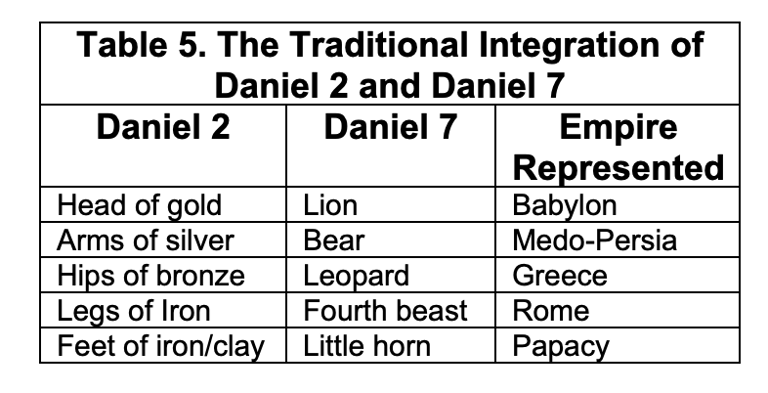
Commentators have always interpreted this sequence of empires the same as they have the beasts of Daniel 7: Babylon, Medo-Persia, Greece, and Rome. Table 5, somewhere on this page shows the comparison of these chapters as they have been traditionally interpreted.
This interpretive scheme has served students of Bible prophecy well for two thousand years. It is amazing that the Bible prophesied the leading kingdoms of the world before they appeared on the stage of history. But here, as we have seen elsewhere in Daniel, the traditional interpretations from the past are inadequate for the present. We are near the border of time and Daniel’s little book is being “unsealed.” A stone cut out, “not by humans,” strikes this image at its feet and the whole image is destroyed. Almost all commentators recognize the stone as the Messiah, not of human derivation. His return will destroy the wicked, as it says
And then shall that Wicked be revealed, whom the Lord shall consume with the spirit of his mouth, and shall destroy with the brightness of his coming… (2Thessalonians 2:8)
This is the second coming of Jesus. But when He returns, there will be no Babylon, no Medo-Persia, no Greece, no Rome. Those nations are in their historical graves. So while those may have been the countries the prophecy was pointing to in centuries past, we are again finding textual reasons to believe that this chapter has an application for the days in which we live.
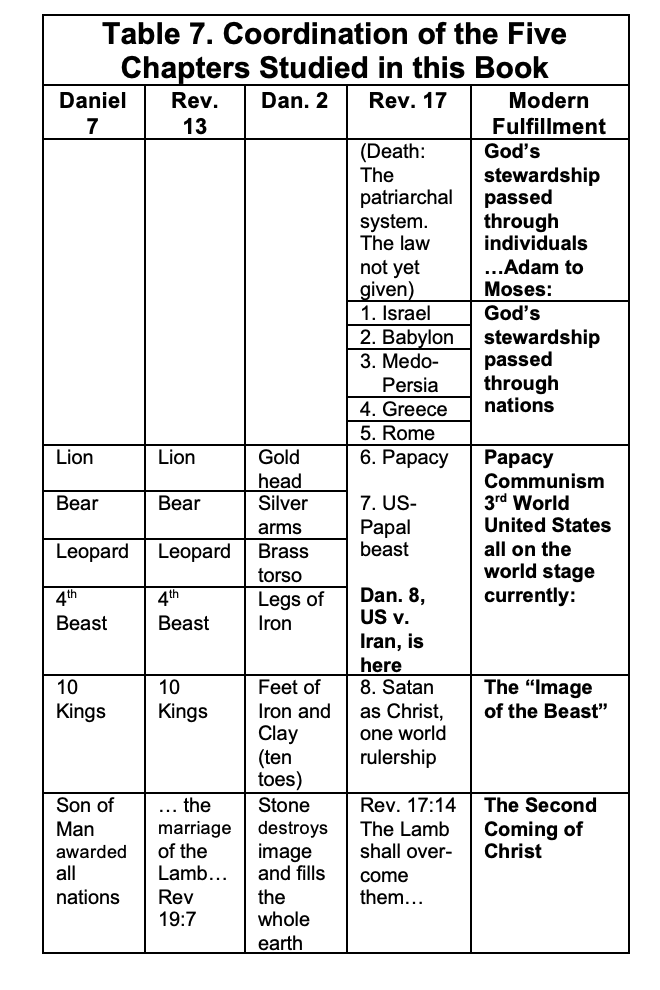
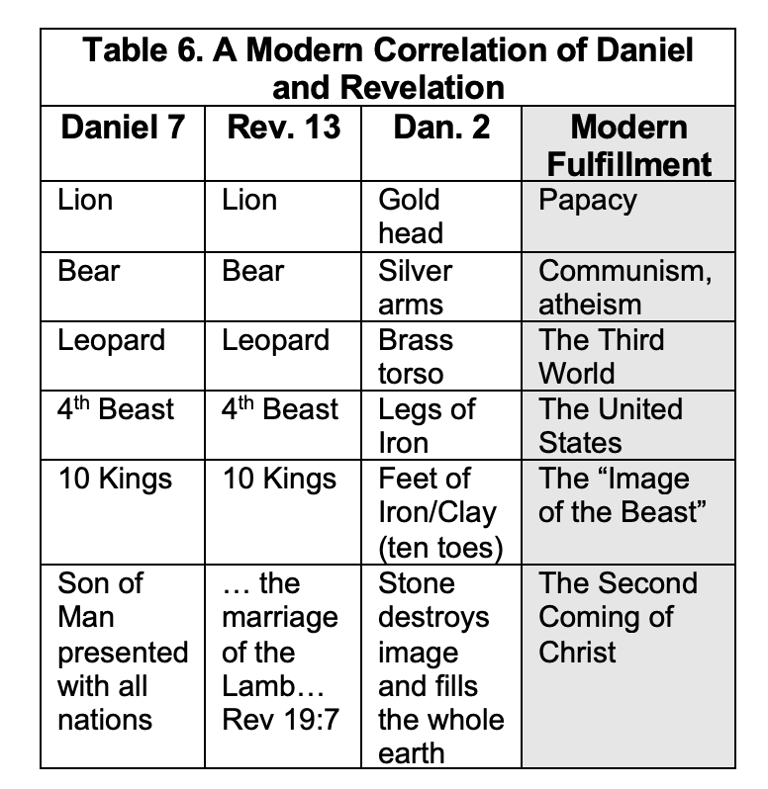
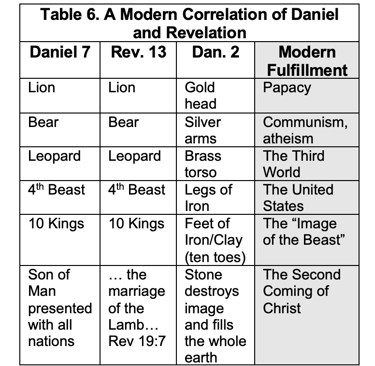
Lining up its images with those of chapters we have already studied, it can be seen that Daniel 2 also adds details to earth’s closing configuration of powers, including the United States.
Consider the comparison of Daniel 2 to Daniel 7 and Revelation 13 in Table 6 which is somewhere on this webpage...
Notice that the materials in the image of Daniel 2 grow increasingly less precious as they reach the feet. The Papacy is golden because of its power to act with relative unity and solidarity. Heaven acts this way, and unity is one of the most powerful New Testament concepts. Gold symbolizes that which is precious. The gold head also has the mouth and brains, powers the Papacy supplies in the final schema of nations.
The silver arms represent the force of arms that Russia, North Korea and other atheistic, communistic powers have. There is strength in the image to fight with his arms and fists. Most artists conceive of this image with the arms folded over the chest. As such, the arms of the image would be the manifestation of a one-world government, not at war with itself. Power is precious if it can help keep peace.
The bulk of the image is made up of the bronze torso, thus representing the bulk of the world’s population, the Third World. Here are the stomach and genitals, the organs that symbolize desire and the lower human instincts and the raw material from which the human race is made. As the American political theorist James Madison knew, these are the passions that governments must be fashioned to control. The final one-world state configured by the antichrist and the devil will have the pride of the Titanic in thinking it has solved the ancient problem of all governments. However, the final segment of the image provides the telltale iceberg which will cause sure devastation to this attempt at a one-world government.
As Daniel explains the dream to the ruler:
…it will be a divided empire…. The toes---partly iron and partly clay---mean that part of the empire will be strong and part of it weak. (Dan 2:41-42)
The fact that the image cannot hold together because of the mixture of iron and clay means that the one-world government it represents cannot hold together. The iron is a symbol of a strong governmental structure, but the clay is a symbol of human nature. The iron represents the contribution of the United States to this final one-world conglomerate. This is the iron Constitution which was designed by wise Founding Fathers to pit ambition against ambition. The separated powers of government and institutional checks and balances were the solution to governing “the people.”
Adam, the first man, was formed from the clay of the ground, in fact, the name Adam means “red,” deriving from the color of the clay. The great United States is indeed an iron governmental structure, but being intermixed with the clay of centuries of humanity, it will find it cannot redeem the greed of Enron and WorldCom, the greed of internet-tempted stock “investors,” the lust for political power and sexual addiction, the unholy passion of revenge on Islamic fundamentalists. The gold at the top of the image stands for unity and solidarity, but the clay at the bottom of the image is a reminder that all the strength of gold (unity), silver (armaments), bronze (masses of people) and iron (strong government) have this one major limitation: at their base, there are mixed with the frailty and fickleness of human nature.
No, the iron of the United States will not be able to save the one-world governmental structure with which it will be associated from falling into the same scrapheap littered with the previous attempts of Nimrod, Alexander, Caesar, Cyrus, Charlemagne, Louis XIV, Napoleon, and Hitler.
And as the toes of the feet were part of iron, and part of clay… but they shall not cleave one to another, even as iron doth not mingle with clay. (Dan 2:42-43)
The “toes”—an anatomical allusion to the ten kings referred to in Revelation 17 and Daniel 7—will not cleave together. Even though it will appear that this union of nations that takes place after the economic collapse of the United States will have a strong bond, (“These ten all have the same purpose, and they give their power and authority to the beast.” Rev 17:13), the simple prophecy of Daniel 2 prophesies their ultimate fate: “they shall not cleave one to another.”
As Daniel informed Nebuchadnezzar, and as his little book reminds all who read it, there is only one kingdom that will hold together and stand forever:
At the time of those rulers the God of heaven will establish a kingdom that will never end. It will never be conquered…. You saw how a cut stone without human origin struck the statue made of iron, bronze, clay, silver, and gold. The great God is telling Your Majesty what will happen in the future. I have told you …what you dreamed." (Dan 2:44-45)
Daniel and Revelation have faithfully related what is coming. The United States will obliterate a pair of Middle Eastern Islamic powers, one being Iraq, the second likely Iran. It will soon after suffer a severe economic collapse. The world will then receive a new governmental configuration, an image to the beast, with the U.S. as an instigator. This power will persecute God’s people.
And what will be the strength of these believers during the days of persecution? They will have a relationship with the God whose kingdom will never be destroyed. They will be assured of their acceptance by the Maker of Heaven and earth.
May each reader of these pages find this eternal kingdom, and so be on the victorious side in the final battle of Armageddon. That this battle is indeed a spiritual battle, and not the nation-against-nation clash as it is so often described by writers, is shown by Jesus’ words in the battle of Armageddon, recorded in the book of Revelation:
…the kings of the earth and of the whole world,…gather…to the battle of that great day of God Almighty. (15) "Listen! I am coming like a thief! Happy is he who stays awake and guards his clothes, so that he will not walk around naked and be ashamed in public!" (Revelation 16:14-15)
All the kings of the world are gathered in a one-world government. Jesus does not tell believers to get their guns ready. He says to stay awake and be clothed. Jesus is not giving sleeping and wardrobe lessons. Both “staying awake” and “being clothed” are metaphors for trusting in God’s forgiveness. When you trust in God, you are wide-awake and clothed in the white garments of His righteousness.
Even so, come quickly, Lord Jesus!