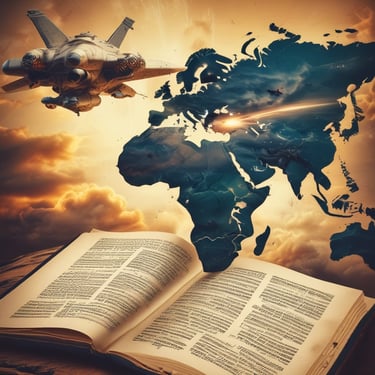
Daniel 8 wrote about the US-Iran Conflict 2500 years ago...
Don't read if you can't handle strong truth...
Daniel 8
Where is the US-Iranian War in Bible Prophecy?
An angry goat is charging at a ram. In a rage the goat pummels the ram, smashing it to the ground. Furious hooves trample the ram until the life is beaten out of it. The awful excitement and horror of a drama usually found in the dark arenas that attract men worldwide to dogfights and cockfights can be found in the middle of one of the Bible’s prophetic books. Promoters use this gladiatorial savagery to draw a crowd to increase their take. In this case the promoter is God, using the writings of the prophet Daniel. What is His purpose in drawing a crowd around this animal brutality?
We pick up our study in the eighth chapter of the Old Testament prophetic book of Daniel. In this chapter, Daniel receives a vision. He also hears the words of an angelic being who has been instructed to help him understand the vision.
We would be foolish to try to interpret the meaning of this vision apart from the commentary provided by the angel.
The vision involves a ram with two horns being attacked by a goat from the west that has one notable horn. These animals and their horns represent nations. This conclusion can be drawn by a look at the previous chapter. In the seventh chapter of Daniel, the angel tells Daniel what the four beasts that he sees represent.
"These four huge beasts are four empires which will arise on earth." (Dan 7:17)
The angel says beasts are empires. Animals represent nations, empires. This is not a radical or eccentric idea. Political cartoonists regularly represent nations by drawing animals. The bear represents Russia.
But what do rams and goats represent? We will want the angel who appears in this chapter to tell us which particular empires are represented by the animals appearing in the vision in Daniel 8.
Another question we want the interpreting angel to answer is "When does this vision apply? To what time period does it refer?" The angel does not disappoint us in providing the identity of the nations represented by ram and goat and the time frame of their appearance.
As to the question of the time of the vision, the angel says three different times that the vision is for the time of the end:
1. v. 17: Understand, O son of man: for at the time of the end shall be the vision.
2. v.19a: I will make thee know what shall be in the last end of the indignation:
3. v.19b: for at the time appointed the end shall be.
The angel is being very clear that this vision is for the end of time. This is an angel from Heaven speaking, not a human Bible interpreter. It is important to take note of this because most Bible commentators say that this vision deals with Alexander the Great.
A simple glance at the books on the church shelves and the Christian libraries, a read of all the major commentaries, a consult with the famous radio and TV preachers and a check of materials at the seminaries will agree. The verdict is well nigh unanimous. Because biblical commentators for centuries interpreted this vision to be a symbolic representation of Alexander's defeat of the Persian armies it is understandable that we would follow suit. But now we are hearing the words of an angel from Heaven. While it might be our normal default mode to heed the biblical experts, it seems more prudent, when given the chance, to listen first to the voice of an angel from Heaven.
If the angel’s words can be taken at their face value, then the ultimate application of Daniel’s vision is for a time long after that of Alexander the Great.
As to the second area where we would look to the interpreting angel for help, that of the nations represented by these beasts and horns, the angel gives the following very plain declaration:
20 The ram which you saw having two horns are the kings of Media and Persia. 21 And the rough goat is the king of Grecia: and the great horn that is between his eyes is the first king.
Note in verse 21 that the goat is said to be a king, and then the "great horn" is also said to be a "king." "King" is from a Hebrew word that is usually translated "reign," and so carries the idea of a “kingdom.” Thus the goat appears to represent a "kingdom", a territory of potentially vast proportions, whereas the horn would seem to represent a “kingdom” that is a part of the other, larger kingdom.
If we are going to be loyal to the interpreting angel, we must find modern meanings for the phrase "kings of Media and Persia." While common sense might say that these names can only refer to the ancient past, that is, the former kingdoms of Media and Persia, a look at the words of the interpreting angel given above would indicate otherwise. When angels give directions, it is best to listen.
A simple check of any encyclopedia will tell us that modern Iran was formerly called Persia. What about “Media?” The modern ethnic Kurds are the largest people group in the world without a home country. They dwell in several countries, including Iraq. The Kurds claim to be descendants of the ancient Medes, and thus it would be fair to say that the angel is using the name of the ancient nation of "Media" to refer to the area where it once existed, now the approximate area of Iraq and Syria.
We are given another rather interesting clue in this chapter about the nature of the kingdoms we are looking for. In the previous chapter, Daniel 7, ceremonially unclean animals, a leopard, a lion, and a bear, were used to represent heathen nations. But here in Daniel 8, Daniel is shown a vision which has sacrificial animals: a ram and goat. Sacrificial animals would imply religious conflict, and religious, not secular, nations. Given the geography we have just uncovered, which includes the nations of Iran, Iraq, and Syria, it could be rationally and logically concluded that the "reign" referred to above is that of Islam.
Another evidence from the text highlighting this secular/religious dichotomy in these visions is that Daniel 7 is written in Aramaic, the tongue of the Gentiles, and Daniel 8 is written in Hebrew, the tongue of the Jews.
The ram symbolizes the fundamentalist power of Islam in the Middle East in a life-or-death struggle with the goat, representing Greece. What power in the modern world is represented by the interpreting angel's mention of "Greece?"
If we insisted on interpreting the angel's words with the literalism that Biblical conservatives and fundamentalists often insist upon, we would be forced to say that “Greece” means the modern nation of Greece.
But the Bible must be interpreted with more than simple literalism. For example, Jesus regularly used metaphors and parables. The Bible is filled with metaphors. They are one of its key interpretive mechanisms. When Jesus was asked about His parable of the sower, in which a farmer sows seed in various places, He explained that the seed is really a metaphor or symbol for the word of God. Jesus chastised His disciples for not having the understanding of the simple interpretive mechanism of metaphor.
He said, “How then will you understand all of the parables?” (Mark 4:13), indicating the profound place reserved for metaphor. The seed is not a seed, it represents the word. A farmer is not a farmer, he represents an evangelist. Weeds are not weeds; they represent the cares of this world.
What then does the angel mean by the term “Greece?” The apostle Paul talks about “Greeks” several places in the New Testament but he is not referring to people who live in Greece. Instead he is referring to people who live in the civilized world. For example:
"For the Jews require a sign, and the Greeks seek after wisdom: 23 But we preach Christ crucified, unto the Jews a stumblingblock, and unto the Greeks foolishness;" (1 Cor 1:22-23)
The Greek word hellen, here translated "Greeks" is also translated as "Gentiles" and basically means a person who speaks Greek, not necessarily someone from the literal country of Greece. Greek was the language of the learned. It carried the culture which began with the famous ancient Greek poets and philosophers and ultimately became the basis for what today we call "Western civilization."
Notice that this goat comes from the "west." (v. 5) Thus we have pictured here, in cartoon form, the struggle between Islam and Western civilization, rooted in the culture of Christianity. Since September 11, 2001, is there any struggle on the face of the earth more prominent? The Bible, here in Daniel 8, has zeroed in on our time with amazing singularity.
It is the province of most works on Bible prophecy to focus on what is happening in the Middle Eastern land of Israel. However, in the prophetic sections that comprise the text for our current study, the nation of Israel is a non-factor. It is the nation of the United States that arises front and center in the biblical chapters we will be examining.
The angel tells us that the prominent horn on this goat is "the first king." (v. 21)
Here the word translated "first" means "foremost", not necessarily first in terms of order. Who is the foremost, the "first", nation of modern Western civilization? It is certainly the United States of America, the wealthiest country in the history of the world. Thus we have pictured here in Daniel 8 a vision of the clash of civilizations East and West, a clash of religious cultures, Islamic and Christian.
The prophecy says that two major ram horns, or powers, will arise. The symbolism is saying that two kings or nations will arise from this region, who will tangle with the West.
The first would seem to be the nation of Iraq and its former powerful dictator Saddam Hussein. When his regime was in power there was no diplomatic window dressing. He hated the West and taunted the U.S., calling it “the great Satan.” And, of course, Iraq was invaded by the U.S. The prophecy said the two powers were Media and Persia. Saddam's Iraq would seem to be the first horn of the ram, the power called “Media.” If so, we can now look for another, the Persian, because the prophecy is plain that the ram has two horns. Now that Iraq has been crushed by the economic and military power of the U.S., who is the other horn, the “Persian” horn?
For centuries the land now known as Iran was called “Persia.” It is to Iran that we should look for the fulfillment of the second Islamic horn.
Let us look at the description of these two horns in Daniel 8. The prophecy says:
Then I lifted up mine eyes, and saw, and, behold, there stood before the river a ram which had two horns: and the two horns were high; but one was higher than the other, and the higher came up last. (Dan 8:3)
As for these two horns being “high”, the Hebrew word carries the idea of being proud. Most observers would agree that Saddam Hussein is a very proud man. As proud as he was before his fall, this prophecy says that the next Middle Eastern power will be even more proud, more haughty. For the original readers of this book, written before and just after the U.S. invasion of Iraq, that successor seemed to be Iran, led by the fiery rhetoric of Mahmoud Ahmadinejad.
The Seventeen-Year Gap (I wrote this book 17 years ago, but here are the updates which bring it current to 2026): From Ahmadinejad to Khamenei
The years since 2009 have tested and, in many ways, deepened the relevance of this prophecy. The "second horn" did not merely remain proud; it became the dominant strategic power in the region. While Iraq crumbled, Iran's influence expanded through its proxy network: Hezbollah in Lebanon, Shia militias in Iraq, the Houthis in Yemen, and the Assad regime in Syria. The "higher horn" that "came up last" seemed to be not just a single nation, but a hydra-headed Islamic resistance, with Iran as its head.
The U.S. response was not a single, furious attack as earlier analysts envisioned. First came the Obama administration's nuclear deal, the JCPOA (Joint Comprehensive Plan of Action), in 2015. This was an attempt to defuse the conflict diplomatically, to prevent the need for the "fury" described in verse 6. For a moment, the path of the prophecy seemed to diverge.
Then came the Trump administration. The "fury" returned with a vengeance. In 2018, President Trump withdrew the U.S. from the JCPOA, calling it a "terrible one-sided deal that should have never, ever been made." This was the first act in a new drama. The prophecy spoke of a goat moving in "fury" (Dan 8:6). The Trump administration’s "maximum pressure" campaign—crippling economic sanctions, the designation of the Islamic Revolutionary Guard Corps (IRGC) as a Foreign Terrorist Organization—was an expression of that fury, designed to economically "smite" the ram.
The Death of the Ayatollah
In the escalating conflict that followed, the United States demonstrated that no figure in the Iranian hierarchy was beyond reach. Ayatollah Ali Khamenei, the Supreme Leader of the Islamic Revolution, the man who had held the final say on all major decisions in Iran since 1989, who had outlasted nine American presidents, who had called America the "Great Satan" for four decades—he was killed in a precision strike on a compound in Tehran.
The news sent shockwaves through the Islamic world. Here was not merely a military commander, not merely a nuclear scientist, but the very embodiment of the Islamic Republic itself. Khamenei was the "higher horn" personified—the pride of Persia made flesh, the voice that had declared "Death to America" at countless Friday prayers, the hand that had shaped Iran's regional empire through proxies and terror.
His death was the fulfillment of decades of prophecy-watchers who had seen in Daniel 8 the image of the proud horn being broken. But the prophecy was not finished.
The Son Rises
If Khamenei's death was meant to break the spirit of Iranian resistance, the aftermath proved otherwise. His son, Mojtaba Khamenei, long groomed for succession within the inner circles of the Revolutionary Guard, emerged as the new Supreme Leader. And his first public addresses were not the muted, conciliatory tones of a man chastened by American power. They were defiant. They were proud. They were, in every respect, the same anti-American slurs that had defined his father's rhetoric for half a century.
Mojtaba stood before the assembled clerics and commanders and declared that Iran would never bow to the "Great Satan." He vowed revenge for his father's blood. He promised that Iran's nuclear program would be rebuilt, that its proxies would redouble their attacks on American forces, that the Islamic Revolution would survive and ultimately triumph over its enemies.
To those watching through the lens of Daniel 8, the message was unmistakable: the "higher horn" had not been broken. It had merely been replaced. The pride remained. The obstinacy remained. The defiance remained.
The "Wrath" Campaigns
This is the context in which the "Wrath" campaigns must be understood. Beginning in the final year of the Trump administration, and escalating dramatically after his return to office in 2025, the nature of American action against Iran fundamentally shifted. The "maximum pressure" campaign of sanctions gave way to what the prophecy had long foretold: direct, devastating military action designed not merely to punish, but to annihilate.
The bombing campaigns bore names that could have been lifted directly from the pages of Daniel: Operation Burning Fury, Operation Wrath of the Eagle, Operation Final Account. These were not single strikes but sustained campaigns that targeted the very sinews of Iranian power.
The Natanz nuclear facility, heart of Iran's enrichment program, was not merely "set back" as some analysts had described previous covert actions. It was leveled—its centrifuges reduced to twisted metal, its underground halls collapsed upon themselves by bunker-busting munitions that the United States had held in reserve for precisely such a moment.
The Isfahan nuclear complex, the Bushehr reactor, the Fordow facility buried deep inside a mountain—all were struck repeatedly until they ceased to function. The International Atomic Energy Agency would later report that Iran's nuclear program had been set back by at least a decade, its most advanced centrifuges destroyed, its stockpile of enriched uranium scattered and contaminated.
Iran's naval forces were "largely neutralized," according to Trump's own assessment. "They've got no navy. They've got no air force. They've got no anti-air traffic, anything," he declared. "We're just riding free range over that country."
The Islamic Revolutionary Guard Corps—the very institution that the prophecy's "ram" represents—saw its command structure decapitated, its bases cratered, its missile launch sites hunted and destroyed by drones that loitered endlessly over Iranian airspace, waiting for targets to emerge.
This was the breaking of the horns. This was the casting down. This was the stamping upon.
The Solitude of the Ram (Daniel 8:7)
Now consider the full weight of verse 7:
"And I saw him come close unto the ram, and he was moved with anger against him, and smote the ram, and broke his two horns: and there was no power in the ram to stand before him, but he cast him down to the ground, and stamped upon him: and there was none that could deliver the ram out of his hand."
The final clause is precise: no deliverer appears. This is not a statement about the extent of the destruction. It is a statement about Iran's isolation at the moment of its destruction.
Consider who might have been expected to intervene. Russia, despite its strategic partnership with Iran, its sale of advanced S-400 air defense systems, its presence in the region—did nothing. President Putin issued condemnations, recalled his ambassador for consultations, but never fired a shot in Iran's defense. The Russian bear, for all its growling, would not risk direct confrontation with the United States for the sake of Tehran.
China, Iran's largest trading partner and the primary buyer of its oil, made frantic diplomatic appeals for de-escalation. Its state media decried American "hegemony." Its foreign ministry called for "restraint on all sides." But not a single Chinese warship moved to challenge the U.S. Navy in the Persian Gulf. Beijing's interests were economic, not existential; it would not bleed for the Islamic Republic.
Europe—Britain, France, Germany—engaged in the theater of diplomacy. Emergency summits were convened. Solemn statements were issued. Humanitarian aid was pledged. But Europe has no army capable of projecting power into such a conflict, and no appetite for war with its American protector. The European Union, for all its moral pretensions, proved once again that it is a paper tiger when actual force is required.
Turkey, a NATO ally with complex relations with Tehran, saw opportunity in Iran's destruction. President Erdoğan made conciliatory noises toward Washington while quietly positioning Turkish forces to secure territory along the border, should the Islamic Republic collapse entirely.
The United Nations proved, yet again, the accuracy of those who had long called it a debating society rather than a governing body. Resolutions were proposed, vetoed, ignored. The Security Council revealed its essential impotence in the face of determined great-power action.
The Papacy, the "first beast" of Revelation 13 with its vast moral influence, pleaded for peace. The Pope issued encyclicals on the sin of war. Vatican diplomats shuttled between Washington and Tehran. But the Pope's voice, however revered, did not stay the hand of the United States.
This is the geopolitical reality the angel foretold: a moment of American freedom so complete, so unchecked by any countervailing power, that Iran stood utterly alone. No Russian Bear intervened. No Chinese Dragon extended its claw. No European conscience formed a human shield. No moral authority, however lofty, stayed the hand of the United States.
The ram looked for a deliverer and found none.
The Question of Finality: The Electric Grid Strategy?
And yet, Mojtaba Khamenei still speaks. The pride still speaks. The question hangs in the air: has the prophecy been fully satisfied? Have the horns been so completely broken that Iran will never rise again? Or does the continued defiance of the son suggest that the work remains unfinished?
This is where Trump's words about the electric grid take on their full, terrible significance. In March 2026, as the conflict reached its crescendo, President Trump made an extraordinary statement to reporters at Joint Base Andrews. When asked about the possibility of further escalation, he laid bare the awesome power the United States held in reserve:
"We could take apart their electric capacity within one hour. And it would take them 25 years to rebuild it."
Twenty-five years of darkness. Twenty-five years without the power to run hospitals, to pump water, to sustain the modern infrastructure upon which all nations depend. Twenty-five years in which the Islamic Republic would cease to function as a state.
The president said "we won't do that." But the very fact that such capacity exists, and was openly discussed, signals to Tehran that the line has been drawn but not yet crossed. And if the son continues to speak with the same pride as the father, if the regime continues to exist, if the capacity for defiance remains—then the pressure to cross that line becomes almost irresistible.
Because the prophecy envisions not merely a wounded ram, but a ram whose horns are broken—whose power to gore, to threaten, to rise again has been eliminated. If Mojtaba Khamenei can still summon the faithful to resistance, can still promise the rebuilding of the nuclear program, can still declare "Death to America" from whatever hole he occupies—then perhaps the breaking is not yet complete.
The logic of the prophecy, and the logic of American power, point toward the same conclusion: if the son will not be silent, if the pride will not be humbled, if the ram can still threaten to rise—then the full measure of the goat's fury has not yet been poured out.
And when that final fury comes, the prophecy assures us of two things:
1. Iran will stand utterly alone, with no deliverer appearing from any quarter
2. Its destruction will be total—its horns broken, its body cast down, its power stamped out of existence
The Pride and the Breaking
What does the prophecy say will happen when the U.S. finally unleashes its full fury upon Iran? The U.S. will become very proud. Verse 8 says:
"Therefore the he-goat waxed very great."
When the Natanz facility lies in ruins, when the Revolutionary Guard has been shattered, when the Ayatollah—father and son—have been silenced, when the world watches in silence offering not a single hand to help—America will rejoice.
We will be so proud of our Super Bowl victory over these Islamic adversaries. The stock market will surge. The president's approval ratings will soar. Pundits will declare a new American century, a Pax Americana renewed by fire and fury. The pundits will be wrong.
Verse 8 also succinctly says:
"...and when he was strong, the great horn was broken."
Here is the plain biblical revelation of the fate of the U.S. The trash-talking victory dance will be short-lived. This is the time to get your money out of the market. The symbolism of the "great horn"—the U.S.—being "broken" is a graphic picture of the economic collapse of the U.S. That's what is depicted by the symbolism of a horn being broken. The horn is not vaporized. The U.S. will still exist. But if the economy of the U.S. suffers a massive depression, the whole world will be weakened, and the U.S. will suffer what all countries experience in such a depression.
The pride comes first—the pride of a nation that has bent the world to its will, that has crushed its enemy with none to stay its hand, that has demonstrated a monopoly on violence so complete that even Russia and China dare not challenge it, that has contemplated and perhaps executed the final, terrible act of ensuring that the ram will never rise again.
Then comes the breaking.
This is the rhythm of prophecy, and it is the rhythm of history.
A Word of Hope and Warning
I hope that the obliteration of Iran by the U.S. does not happen, and that peaceful solutions can be found for the tensions between these nations. I hope that the U.S. economy recovers and does not ultimately collapse. In my own heart I hope that the interpretation of Daniel 8 offered here is wrong. As I stated in the introduction to this work I am an American, with pride in our nation’s creed, and the liberties we have long guaranteed our citizens. No patriot longs to see the demise of his country.
But my fidelity to my nation cannot stand equal to my attempt to be faithful to God, and what I see in the pages of the Bible. I am trying to faithfully render in these pages what the message of the Bible seems to be. I am putting this into print so that others may have the chance to see what I am seeing. Not everyone will see things as I do. But I must still be true to what I believe the Scripture is saying and what I believe is a word from God for our time.
Let us each then continue this pursuit of America’s place in Bible prophecy by looking into Revelation chapter 13.