Prophecy Predicts the future
Daniel 7
Naming the Unnamed Beast
The Four Beasts and the Little Horn
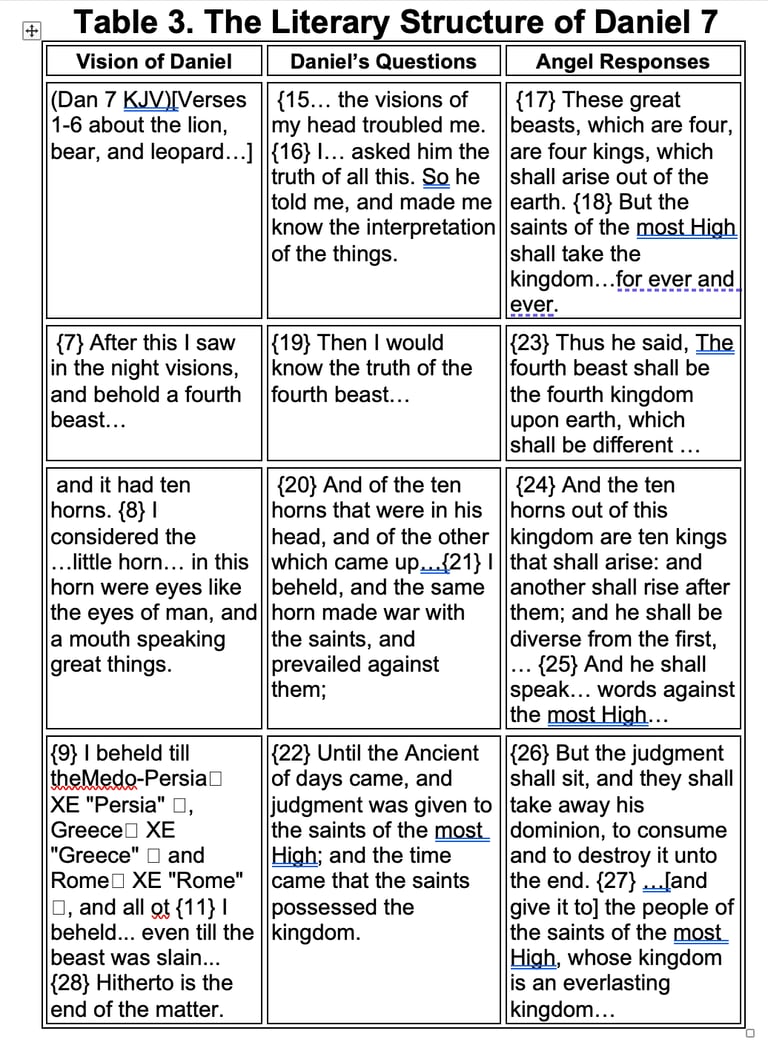
In the seventh chapter of Daniel, we find one of the most extensive and detailed prophetic visions in all of Scripture. Here, Daniel sees four great beasts rise from the sea—a lion, a bear, a leopard, and a fourth beast, terrible and dreadful, with ten horns. Then, from among these ten horns, a little horn arises that speaks great words against the Most High.
The angel who interprets the vision for Daniel makes it clear: these beasts are kingdoms. "These four huge beasts are four empires which will arise on earth." (Dan 7:17) Unlike Daniel 8, which focuses specifically on the conflict between Western civilization (the goat) and Islamic power (the ram), Daniel 7 gives us a panoramic view of the succession of world empires that dominate the earth in the time of the end.
As we have seen in the previous chapters, the United States plays a unique role in Bible prophecy—not as one of the traditional world empires, but as a power that arises from the earth (Revelation 13), as the great horn of the goat that crushes the ram (Daniel 8), and as a nation that helps bring forth the "image of the beast" (Revelation 13). In Daniel 7, we must look carefully to see where America fits in this succession of beasts.
The Four Beasts
The four beasts that Daniel sees are described as follows:
The first was like a lion, and had eagle's wings: I beheld till the wings thereof were plucked, and it was lifted up from the earth, and made stand upon the feet as a man, and a man's heart was given to it. (Dan 7:4)
The lion with eagle's wings is universally recognized by interpreters as representing the Babylonian Empire. Babylon was the great power that conquered Judah, destroyed Jerusalem, and carried Daniel himself into captivity. The wings represent the swiftness of Babylonian conquest; their plucking represents the humbling of Nebuchadnezzar when he was driven from his throne to eat grass like an ox, after which he was given a man's heart.
And behold another beast, a second, like to a bear, and it raised up itself on one side, and it had three ribs in the mouth of it between the teeth of it: and they said thus unto it, Arise, devour much flesh. (Dan 7:5)
The bear represents the Medo-Persian Empire, which conquered Babylon and became the dominant world power. The bear raising itself on one side represents the dominance of Persia over Media within the combined empire. The three ribs in its mouth represent the three major conquests of the Medo-Persian Empire: Babylon, Lydia, and Egypt.
After this I beheld, and lo another, like a leopard, which had upon the back of it four wings of a fowl; the beast had also four heads; and dominion was given to it. (Dan 7:6)
The leopard represents the Greek Empire under Alexander the Great. The four wings represent the speed of Alexander's conquest—he swept across the known world with astonishing rapidity. The four heads represent the division of Alexander's empire after his death into four kingdoms: Macedonia, Thrace, Syria, and Egypt.
After this I saw in the night visions, and behold a fourth beast, dreadful and terrible, and strong exceedingly; and it had great iron teeth: it devoured and brake in pieces, and stamped the residue with the feet of it: and it was diverse from all the beasts that were before it; and it had ten horns. (Dan 7:7)
The fourth beast is different from all that came before it. While the previous beasts had recognizable forms—lion, bear, leopard—this beast has no name. It is simply a beast, dreadful and terrible. This is the Roman Empire, the greatest of the ancient world empires, which conquered Greece and established a dominion that stretched from Britain to Egypt, from the Atlantic to the Euphrates.
The ten horns represent ten kingdoms that arose from the breakup of the Roman Empire. Most interpreters identify these as the barbarian kingdoms that settled in the territories of the Western Roman Empire: the Vandals, Visigoths, Ostrogoths, Franks, Burgundians, Lombards, Suevi, Heruli, Alemanni, and the Saxons. But the angel's interpretation suggests that these ten horns are not merely historical artifacts; they have significance for the time of the end.
The Little Horn
Then, from among these ten horns, another horn arises:
I considered the horns, and, behold, there came up among them another little horn, before whom there were three of the first horns plucked up by the roots: and, behold, in this horn were eyes like the eyes of a man, and a mouth speaking great things. (Dan 7:8)
This little horn is a power that arises after the ten horns are established. It is "little" at first, suggesting humble beginnings, but it grows in power. It plucks up three of the first horns by the roots, indicating that it achieves dominance by subduing three of the ten kingdoms. And it has eyes like a man—suggesting intelligence, cunning, perhaps even the ability to see what others cannot—and a mouth speaking great things, that is, blasphemies against God.
The angel's interpretation makes clear who this little horn represents:
Thus he said, The fourth beast shall be the fourth kingdom upon earth, which shall be diverse from all kingdoms, and shall devour the whole earth, and shall tread it down, and break it in pieces. And the ten horns out of this kingdom are ten kings that shall arise: and another shall arise after them; and he shall be diverse from the first, and he shall subdue three kings. And he shall speak great words against the most High, and shall wear out the saints of the most High, and think to change times and laws: and they shall be given into his hand until a time and times and the dividing of time. (Dan 7:23-25)
Historically, this little horn has been identified with the Papacy. The Papacy arose from among the ten kingdoms of the former Roman Empire, beginning humbly as the bishop of Rome, but gradually growing in power and influence. It subdued three of the ten kingdoms—the Heruli, Ostrogoths, and Vandals—that held Arian theological views opposed to Roman orthodoxy. It speaks great words against the Most High, claiming powers and titles that belong to God alone. It wore out the saints of the Most High through centuries of persecution. And it thought to change times and laws—the most famous example being its role in the change of the Sabbath from the seventh day to the first.
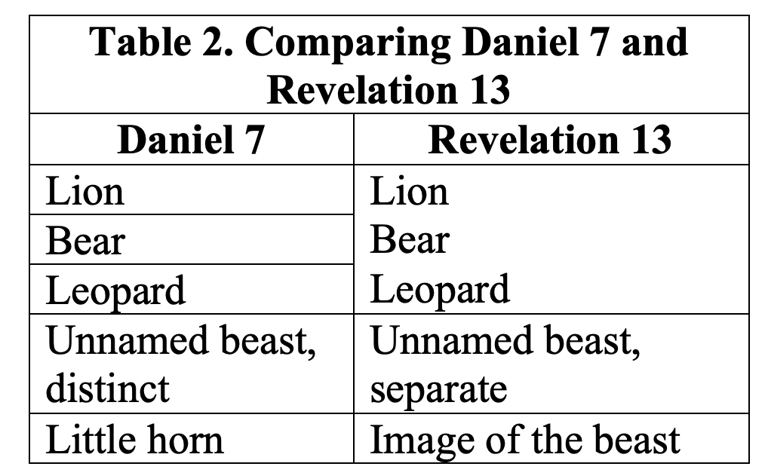
But as we have seen in our study of Revelation 13, the Papacy is not merely a historical power; it is a power that has been "healed" of its deadly wound and that plays a central role in the end-time events. The "first beast" of Revelation 13, which has the appearance of a leopard, bear, and lion, is this same beast system—the Papacy in confederacy with the other powers represented by those animals.
Where Is America in Daniel 7?
The question that concerns us in this book is: where does the United States appear in Daniel 7? The answer is striking: America is not among the four beasts, nor is it among the ten horns, nor is it the little horn. America arises after the prophetic timeline of Daniel 7 has been laid out.
Daniel 7 describes a succession of world empires from Babylon to Rome to the ten kingdoms to the little horn. But the vision does not end with the little horn. There is a judgment scene:
I beheld till the thrones were cast down, and the Ancient of days did sit, whose garment was white as snow, and the hair of his head like the pure wool: his throne was like the fiery flame, and his wheels as burning fire. A fiery stream issued and came forth from before him: thousand thousands ministered unto him, and ten thousand times ten thousand stood before him: the judgment was set, and the books were opened. (Dan 7:9-10)
This judgment is followed by the destruction of the fourth beast and the little horn:
I beheld then because of the voice of the great words which the horn spake: I beheld even till the beast was slain, and his body destroyed, and given to the burning flame. (Dan 7:11)
Then, after the judgment and the destruction of the beast, the kingdom is given to the saints:
And the kingdom and dominion, and the greatness of the kingdom under the whole heaven, shall be given to the people of the saints of the most High, whose kingdom is an everlasting kingdom, and all dominions shall serve and obey him. (Dan 7:27)
Where, then, is America? America arises in the gap between the time of the little horn and the judgment. America is the "great horn" of the goat in Daniel 8, which arises from the West and crushes the ram. America is the "second beast" of Revelation 13, which arises from the earth and speaks as a dragon. America is the unique power that emerges in the final phase of world history, before the judgment, to play its part in the great conflict between East and West, between Islamic theocracy and Western civilization.
Daniel 7 does not include America in its list of world empires because America is not a successor to Rome in the same way that the ten horns and the little horn were. America is a new power, arising from a different place, with a different character, to fulfill a different role. It is not one of the traditional empires of the Old World. It is the nation that arose from the earth—unpopulated, unencumbered by the old world's religious wars—to become the greatest power the world has ever seen, and then to fall.
The Little Horn Today
In our study of Revelation 13, we saw that the "first beast" (the lion-leopard-bear conglomerate) suffered a deadly wound but was healed. That healing is evident in our time. The Papacy has recovered from the losses it suffered during the French Revolution and the unification of Italy. It is now a major voice in world affairs, respected by leaders of every nation. Its influence extends far beyond the Catholic Church; it shapes global discourse on peace, justice, and morality.
But the healing of the beast is not merely the restoration of the Papacy's influence. It is the restoration of the beast system—the confederacy of the Papacy, the communist powers (the bear), and the Third World (the leopard). We see this confederacy forming in our own day. The Pope speaks, and the world listens. The Pope meets with communist leaders, and doors open. The Pope travels to Africa and Asia, and millions gather to hear him.
And where is America in this emerging confederacy? According to Revelation 13, America is the power that causes the world to worship this beast. The United States, in its weakened state after the crushing of the ram and the breaking of its own horn, uses its remaining power—its moral influence, its military might, its technological supremacy—to point the world toward the first beast.
This is a remarkable reversal. America, founded on the principle of separation from the ecclesiastical powers of Europe, becomes the agent that leads the world back to those powers. America, the nation that guaranteed religious liberty in its Constitution, becomes the power that compels the world to worship an image of the beast. America, the lamb-like nation, learns to speak as a dragon—and what it speaks is a call to worship.
The Eyes and the Mouth
The little horn had "eyes like the eyes of a man, and a mouth speaking great things." (Dan 7:8) The eyes represent intelligence, cunning, the ability to see what others cannot. The mouth speaking great things represents blasphemy—claims to divine authority, assertions of power that belong only to God.
The Papacy has certainly fulfilled this description. It claims to be the Vicar of Christ, the head of the church, the infallible voice of God on earth. It speaks great words against the Most High, not by denying God, but by claiming to speak for Him in ways that supersede His Word.
But the second beast of Revelation 13 also has a mouth—and that mouth speaks as a dragon. The lamb-like nation learns to speak the same blasphemies, not necessarily in religious language, but in political language. It claims to be the savior of the world. It asserts that its power is for the good of all humanity. It demands allegiance and offers security in return.
In the final days, the dragon (Satan), the first beast (the Papal-led confederacy), and the second beast (the United States) will form an unholy trinity. The dragon gives power to the first beast; the second beast causes the world to worship the first beast; and the image of the beast (the global governmental structure that mimics the first beast) will be empowered to enforce the mark that controls buying and selling.
The Time of the End
Daniel 7, like Daniel 8, points to the time of the end. The little horn persecutes the saints "until a time and times and the dividing of time"—that is, for 1,260 prophetic days, or literal years. This period, which began with the Papacy's rise to power and the beginning of its persecution of dissenters, ended with the wound that the beast received. But the beast is healed. And the time of the end is the time when the beast, healed and restored, exercises its power once again.
The United States, in this final scenario, is not the beast. It is not the little horn. It is the power that enables the beast to rise again. It is the nation that, having exhausted itself in its fury against the ram, having broken its own horn in the pride of victory, turns to the beast for the order and security it can no longer provide for itself.
A Warning to America
This is the warning of Daniel 7 for America: do not be the agent that causes the world to worship the beast. Do not use your power, your influence, your military might to compel allegiance to a system that claims to speak for God but speaks instead for the dragon.
The founders of this nation understood the danger of ecclesiastical power. They had seen the centuries of bloodshed that resulted from the union of church and state. They had read the accounts of the Inquisition, the wars of religion, the persecution of dissenters. They determined that America would be different—that here, the church would be free from the state, and the state would be free from the church.
But that determination is now being forgotten. A new generation of American Christians, hungry for power, seeks to use the machinery of government to impose its moral vision on the nation. They do not see that they are riding the beast—and that the beast will eventually devour them.
The beast always devours its riders. The state, once it has used the church for its purposes, will discard the church. The power that the church seeks will become its destroyer. The harlot will be made desolate and naked, and her flesh will be eaten, and she will be burned with fire.
America, the lamb-like nation, must choose. It can continue on its present course—speaking as a dragon, causing the world to worship the beast, using its power to compel rather than to persuade. Or it can return to its founding principles—the separation of church and state, the free exercise of religion, the conviction that liberty is a gift from God and not a concession from the state.
If America chooses the former, the prophecy will be fulfilled. The horn will be broken. The beast will devour the harlot. And the Late Great USA will be a memory, a warning to all nations that pride comes before destruction, and a haughty spirit before a fall.
If America chooses the latter, there may yet be hope. God is merciful. He does not desire the death of sinners, but that they turn from their ways and live. Nineveh repented, and God relented. America can repent, and God can relent.
But time is short. The ram is being crushed. The goat is waxing great. The dragon is preparing his final deception. The choice must be made, and soon.
Conclusion
Daniel 7 gives us the panoramic view of world history from the time of Babylon to the end of time. In that panorama, America is not one of the traditional beasts. It is a unique power, arising in the gap between the little horn and the judgment, to play its part in the final conflict. It is the great horn of the goat, the second beast, the lamb-like nation that learns to speak as a dragon.
Its fate is not sealed. Prophecy is warning, not fate. The God who revealed these things to Daniel did so that we might understand the times and know what we ought to do. The choice is before us. May we choose wisely